Imagine you bought a new phone, but at the end of each day, everyday, the operating system crashed. Would you keep using the faulty phone? Of course not. You’d take it back to the store, complain, and get a new one.
And yet, many people run their entire lives on a faulty operating system. It’s called the to-do list. Have you ever met someone who runs their day using a to-do list and actually finishes everything they said they’d do? Me neither.
To-do list devotees keep a running register of all the things they promise to get done, but at the end of the day, they’re surprised to find the list of uncompleted tasks has gotten longer, not shorter. The next day, they repeat the Sisyphean practice. Their days, months, and sometimes entire careers are spent in a harried blur of never getting enough done, even though they’re using a technique that’s supposed to make them more productive.

It’s time to shed the constant stress and toxic guilt of not checking off enough little boxes and finally understanding why running your life with a to-do list is like running your life on Windows 95.
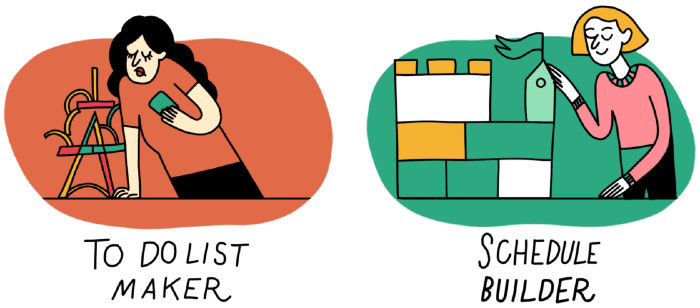
Ultimately, you’ll find that using a schedule builder to make a weekly timeboxed calendar instead of relying on a to-do list is the right way to go, but before we get into that, let’s discuss what’s wrong with to-do lists:
- To-Do Lists Perpetuate Harmful Self-Stereotypes
- To-Do Lists Lead to Distraction
- To-Do Lists Destroy the Fun in Life
- The Best To-Do List is One you Make with a Schedule Builder
Don’t get me wrong—time management practices, like any tool, aren’t inherently harmful or helpful; it comes down to how they’re used. A hammer can be used to build a house or bash someone’s head. When it comes to using to-do lists, getting tasks onto a piece of paper, or into an app, is a very good thing. I do this all the time. No problem there.
What I argue against is the way many people run their lives with a to-do list, as I did for decades. Every morning, when I’d start my work day, the first place I’d look was my to-do list. I’d start checking off boxes, unaware that I was using the tool all wrong. It’s a broken operating system, and I’m glad I’ve updated it. Here’s why.
To-Do Lists Perpetuate Harmful Self-Stereotypes
Ever notice how much easier it is to add things to your to-do list than to actually do them? With no constraints, we just fill up our to-do lists with even more things we’ll never finish.
Back when I was letting to-do lists run my day, I’d blame myself for not finishing tasks. I used to think there must be something wrong with me, or with my inability to follow through. I didn’t realize this negative self-talk reinforced a kind of stereotype that made me less likely to accomplish my goals.
As I described in my book Indistractable, several studies have found that behavior change requires identity change. That is, long-term adherence to a new set of actions necessitates seeing ourselves differently.

If you want to get in shape, you can’t give up one month after setting a New Year’s resolution. You must see yourself as an athlete, so you can commit to exercising for the rest of your life. If you want to effect social change, don’t just vote; be a voter. If you want to stop procrastinating and you find yourself frequently distracted, don’t make promises to yourself you’ll later break; be indistractable.
The difference may seem minor, but several studies have shown we tend to conform to our self-image; identity precedes behavior.
What kind of identity does an ever-incomplete to-do list reinforce? Though there haven’t been direct studies, one can infer from existing research that it isn’t a positive one. Having a constant reminder that you didn’t do what you said you’d do cements a self-stereotype. We begin to see ourselves differently. Day after day, week after week, year after year, the fact that we don’t do as we say takes a toll.
Eventually, we begrudgingly accept not following through.
“I’ll finish it tomorrow,” we tell ourselves. “What’s one more day?”
We repeat this cycle until eventually, and subconsciously, the narrative begins to change from what we do to who we are.
“I’m not good with deadlines,” we say. “I must have a short attention span.”
Faced with the constant dissonance between what we’ve promised to do and what we actually accomplish, we begin to see ourselves as the problem. We stop asking whether our time management system is no good and start to believe, “Maybe I am no good.”
We buy into a self-fulfilling prophecy. This happened to me: I allowed myself to believe I was the kind of person who was “easily distracted,” and I therefore became increasingly distractible. I started telling myself I was “bad at managing my time” and began acting accordingly.
Unfortunately, when we look around and see the endless to-do list apps and productivity “life hacks” telling us to just write things down to get things done, it’s no wonder we think we are the problem. But it’s not you or me that’s “broken.” Rather, it’s the to-do list methodology that’s screwed up.
To-Do Lists Lead to Distraction?
To-do lists are supposed to keep us on task. They don’t. Rather, running your life using a to-do list leads to more distraction, not less. To understand why, it’s important to understand what “distraction” is—really.
A distraction is any action that pulls us away from what we intend to do. The opposite of distraction is not “focus.” It’s “traction.” Both words come from the same Latin root trahere, which means “to pull.” Both words also end with the same six-letter word, “action,” reminding us that both “traction” and “dis-traction” are actions we decide to take, not things that randomly happen to us.

Source: Indistractable: How to Control Your Attention and Choose Your Life
Understanding the distinction between traction and distraction is critical. By this definition, we cannot call something a distraction unless we know what it is distracting us from. Therefore, we can’t say we got distracted unless we have defined, in advance, what is traction for us at that moment in time.
Whether something is a distraction or traction has little to do with the activity itself. Rather, it is forethought that differentiates the two.
Playing video games or watching television can be an act of traction if that’s what you planned to do with your time. Conversely, working on a task most people would laud as “productive” can be a horrible distraction if it is not what you committed to doing with your time.
When I used a to-do list to run my day, I’d start the morning ticking off tasks, thinking I was on point. I didn’t realize I was letting my to-do list lead me towards distractions that were preventing me from reaching my goals.
For instance, even when I knew I had a big project looming and needed to spend the morning working on it to meet my deadline, glancing at my to-do list gave me permission to escape into doing something (anything) else.
Oh! My to-do list says it’s time to rearrange my desktop icons into color-coded, alphabetized folders!? OK! I guess I’ll do that real quick before I start writing that report I’ve been putting off.
When that’s done, I probably still won’t feel like doing the hard work of focusing on that report, so I’m going to reconstruct my to-do list so I know exactly what has to get done for the next six years of my life. Then I’ll get back to writing that report!…or maybe I won’t.

To-do lists allow us to get distracted by the easy or urgent tasks at the expense of the important work. We get pulled off track by the most pernicious form of distraction—the kind we succumb to without realizing it’s happening. We run faster and faster in the name of getting things done, without realizing we’re headed in the wrong direction.
When we realize we didn’t allocate the necessary time to work on the most important tasks, we justify it by telling ourselves, “there isn’t enough time left anyway,” or “I’m not in the mood,” and with a few clicks, we make the hard work disappear by pushing it off to the next day or the next.
“I’ll definitely get to it tomorrow,” we tell ourselves. But of course, with the rotten to-do list system unchanged, we repeat the same hopeless steps the next day.
Not until the deadline looms over us do we realize we could have done better work and would have avoided this crushing stress, if only we’d dedicated ourselves to the important project when we said we would. Instead, we allowed the to-do list to distract us with frivolous tasks that gave us the deceptive feeling of being productive when we didn’t feel like doing what we said we would.
To-Do Lists Destroy the Fun in Life
Finally, and perhaps most annoyingly, there’s what to-do lists do to our leisure time. I call this phenomenon the “tyranny of the to-do list.”
A tyrant is a “cruel and oppressive ruler.” Tyrants make subjects do things against their will and strike fear into people’s hearts. Okay, maybe I’m exaggerating for dramatic effect—no one was beheaded for defying their to-do list. However, to-do lists make us lose our heads in other ways. Namely, they occupy our minds like a hostile army, stressing us out and sapping enjoyment from life.
Before I staged a coup d’etat against my to-do list, I used to let my unfinished tasks invade my thoughts and leisure time. I’d sit down for a pleasant dinner with my family, only to start thinking about all the things left undone on my to-do list. Later, when I’d play with my daughter, the unchecked boxes tormented me and sometimes kept me up at night worrying.

A 2020 study found that intrusive thought, including thinking about what we “should” be doing, can kill the enjoyment of life’s most important pleasures. The tyranny of the to-do list comes not only from its power to waste our time while working, but also its ability to take over our minds while we’re trying to actually have a life.
Time studies show Americans far underestimate how much leisure time they have. Both mothers and fathers in several Western nations spend significantly more time with their children than previous generations. Yet, even though Americans have time to watch on average nearly five hours of television every day, they report feeling busier.
We spend tons of time “relaxing,” and yet, ironically, we feel less relaxed, even when we take a break.
My hunch is that few working professionals today, especially high performers, even remember what leisure time is supposed to feel like. They’ve simply forgotten how wonderful it feels to have the peace of mind of spending time solely focused on their children or taking a walk.
Discover more from Greg Maxwell
Subscribe to get the latest posts sent to your email.